Glacier National Park
National park
4.8 (19923)
Montana
More than 700 miles of trails in a vast park with diverse landscapes & abundant wildlife.
Barbecue grillCycling lanesPicnic tablesPublic restroom

Background: generated illustration, not a photograph of this location.
Plan Lake McDonald water recreation while distinguishing dangerous creek pullouts, unidentified archive stops and Glacier's current road and water restrictions.
Swimming restriction
Follow named water and shoreline restrictions; Lost Lake water entry prohibited. Do not jump, use creek pullouts as presumed entrances or transfer boat permits to swimming.
Location
A closer look
Photos show past visits, not current water levels or swimming conditions. Select a photo to view it larger.
This is a desk-researched listing. A record update or map check does not confirm current swimming permission or water conditions.
Found an error? Send a correction with the location and a source. How we research listings.
The historical Glacier account mentions Lake McDonald, McDonald Creek pullouts and an unnamed eastern lake reached after a waterfall. It does not identify three surveyed bathing entrances. NPS recognizes Lake McDonald beach swimming in its shoreline guidance, but that support must not be transferred to every creek pullout or the unidentified lake.
Check the current park compendium and posted closures for the actual water body. NPS prohibits all water entry at Lost Lake; this does not identify the archive's unnamed lake as Lost Lake. Wildlife-related shoreline restrictions and boating rules have their own scope. A boat inspection or launch permit is not a general swimming authorization.
NPS warns about cold lakes, swift streams and slippery rocks even in summer. Do not follow the former suggestion that scenic McDonald Creek pullouts are excellent swimming entries, and do not jump from rocks or approach waterfall edges. Use current road and trail status before planning a Going-to-the-Sun Road journey; neither a full crossing nor an unnamed eastern hike is guaranteed available. Book camping separately and carry your own drinking water for the outing.
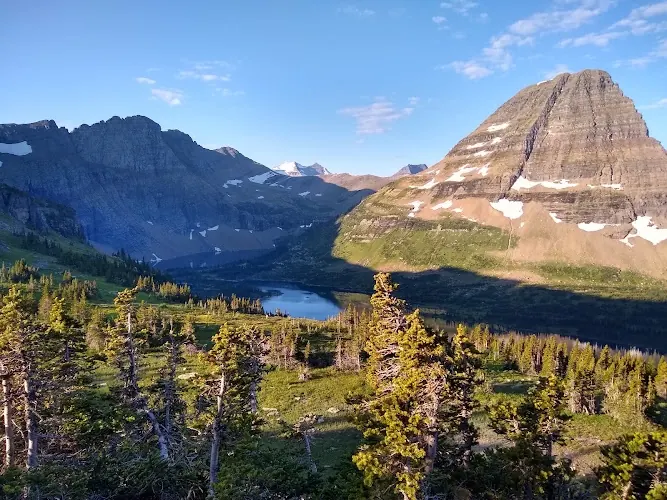
The saved national-park photograph shows a high lake, conifers, rocky peaks and snow patches. It is scenic context, not a located Lake McDonald bathing entrance or confirmation of the archive's unnamed lake. Choose the actual authorized destination using current park maps and notices; do not infer trail access, water temperature or a safe swim from this mountain view.
Check NPS current road/trail status and choose a named authorized destination. Do not follow unsupported McDonald Creek pullout entries or the unidentified eastern lake hike.
Confirm the exact named destination, permitted activity and current notices before travel. Regional sources do not authorize every archived water approach.
Confirm the entrance, parking arrangements, and legal access with the land manager. A map pin does not establish a public right of access. Follow posted routes and never block gates or driveways.
Follow named water and shoreline restrictions; Lost Lake water entry prohibited. Do not jump, use creek pullouts as presumed entrances or transfer boat permits to swimming. Public park access does not necessarily include permission to swim. Respect private property and posted restrictions.
Water conditions can change quickly. This listing does not provide a current safety or water-quality assessment. Check official alerts and avoid entering water when conditions or permission are uncertain.
Bring sturdy water shoes to protect your feet on rocks and slippery surfaces. A waterproof dry bag keeps your phone, keys, and valuables safe. Pack a quick-dry towel, sun protection, and drinking water - never drink from the natural water source.
Nearby places from saved public map data, not necessarily facilities at the swimming spot. Confirm access, hours, fees, and amenities with the operator before you drive.
Map data retrieved 2026-06-15
National park
Montana
More than 700 miles of trails in a vast park with diverse landscapes & abundant wildlife.
National forest
10 Hungry Horse Dr, Hungry Horse, MT 59919
Public bathroom
Kalispell, MT 59901
Campground
825 Helena Flats Rd, Kalispell, MT 59901
RV park
1985 Montana Hwy 35, Kalispell, MT 59901
Portable toilet supplier
374 Willow Glen Dr, Kalispell, MT 59901
Public female bathroom
2150 U.S. 93 S, Kalispell, MT 59901
Campground
1000 Basecamp Dr, Kalispell, MT 59901
No. The archive is a regional visitor account with lake and creek references plus an unnamed eastern lake, not three named current entrances.
Yes. NPS shoreline guidance refers to beach swimming at Lake McDonald. Check the actual beach, current closures and conditions.
Do not assume that. Scenic parking and a creek view do not establish a lawful or suitable bathing entry; NPS warns about swift cold water and slippery rocks.
No. The current compendium prohibits all water entry there. This is a specific named restriction, not proof that the archive's unnamed lake is Lost Lake.
No. Boat inspections, permits, seasons and water-specific restrictions are distinct from bathing and shoreline rules.
Check current Going-to-the-Sun Road and trail conditions first. Do not improvise the unnamed waterfall-to-lake hike from the archived account.
Respect protected sites and local rules; no invented cultural associations.
The reviewed photograph provides broad alpine park scenery. It does not identify Lake McDonald beach access, a McDonald Creek pool or the archive's unnamed lake, and does not establish a current route or water conditions.
Respect property boundaries, use authorized routes and carry out waste.
Browse every listed natural swimming spot in Montana.
Find similar separate lake destinations across the directory.
See under-the-radar places and local favorites in the same state.
Compare easier-access destinations and safer planning options.
Use this safety guide before entering any natural water.
Safety & Access Notice
This information is for general planning only and may be incomplete, outdated, or inaccurate. Access rules, closures, water levels, currents, hazards, and legal restrictions can change at any time. Always verify current rules with the land manager or official source before visiting.
You are responsible for your own safety and for following all posted signs, laws, and local regulations. Read the full disclaimer.
Book an authorized campground separately; no assumed overnight riverbank access.
Loading weather data…
Safety & Access Notice
This information is for general planning only and may be incomplete, outdated, or inaccurate. Access rules, closures, water levels, currents, hazards, and legal restrictions can change at any time. Always verify current rules with the land manager or official source before visiting.
You are responsible for your own safety and for following all posted signs, laws, and local regulations. Read the full disclaimer.
Joshua Havens created Hidden Swimming Holes to make it easier for people to find — and safely visit — natural freshwater swimming destinations across the United States. He researches access conditions, water quality resources, and land management rules so you don't have to start from scratch. He holds a strong belief that good outdoor recreation information should be accurate, honest about its limitations, and freely available.
Discover other amazing natural swimming destinations across America